Poker Psychology Part 1 – The Anatomy of the High-Performance Mind


Poker has a strange aura. It is part game, part a war zone of poker psychology, and erratic enough to feel sentient. You find your seat, shuffle your chips, eye your opponents across the table, and although not a word is said, you feel tension, excitement, uncertainty, optimism, and perhaps anxiety. You know this game is about math, about position charts, about probability. Yet ultimately, there’s something else that decides who leaves with all the chips.
The biographies of the consistent winners – Daniel Negreanu ‘s reading skills, Maria Konnikova’s psychology-focused face-at-the-table approach, the emotionless endurance of top online pros – all seem to echo the same sentiment. People win consistently because it is not about the cards they are dealt; it is about how they respond to each card, good or bad.
This article explores emotional regulation, cognitive biases, decision-making, and lifestyle choices that foster a flexible and resilient mindset. We are going to jump from scientific findings to daily poker realities to sports psychology explorations to implementable strategies that everyone can adopt. Let’s go!
Winning Defined: The Psychology of Poker
The beginner poker player thinks of poker as a game based on rules and memorization. The winning player understands that, from the moment you sit down, you enter a psychological playing field where emotion, perception, history, and, yes, even ego, impact what you do.
This is not hyperbole. It is empirical. The Journal of Expertise features studies suggesting that poker experts differ in cognitive processing from their novice counterparts. Experts regulate emotions better, maintain stable decision-making over hours on end, and assess risk with less bias. Interestingly enough, these experts are no smarter than novices. They are just more stable amid the uncertainty, utilizing poker psychology.
What This Means for You
Winning at poker comes down to something ridiculously simple: You have to make better decisions than other players, more frequently, for longer. That’s it. And this is when poker psychology comes into the picture.
Two Different Mindsets
Alan Longo writes about the difference between two mindsets:
- Result-oriented mindset: “I won, so I played well” or “I lost, so I played poorly.”
- Process-oriented mindset: “I made the best decision with the information I was given.”

The first will keep you emotionally imprisoned by variance; the second empowers you to grow in any situation. Ironically, the less focused you are on winning a certain hand at a certain moment, the more likely you’ll end up winning hand after hand after hand over time.
How High-Performance People Think: A Common Mental Blueprint
High-performance athletes, chess champions, and top-notch poker professionals all share the following mental habits regardless of their field of expertise.
Emotional Neutrality
Pros have emotions, but they don’t write their narrative. Instead, a buffer is established between felt emotion and subsequent action, using poker psychology in practice. Emotional regulation is one of the most researched determinants of performance in high-stress situations, from military operations to tournament poker.

Long-Term Perspective
They’re not obsessed with the result of any specific hand at any point during any given session. They’re perspective-oriented beyond the pitfalls of short-term variance. Sure, it sucks to lose a big pot, but they don’t self-destruct, they just pan out. Researchers have studied this “paradox mindset” in champions: they can hold failure and success in their minds simultaneously without falling apart.
Consistency
Decisions on the second hand of the session look much like decisions on the eighty-third hand and even a hand played ten sessions later. They don’t play tired. They don’t tilt into spewing chips. They keep quality control. And all this is developed and well controlled on the basis of poker psychology.
Self-Awareness
Players always want to blame losing on bad luck. Pros examine themselves, review their hands, challenge assumptions, and hold themselves accountable. This is something psychologist turned poker player Maria Konnikova has discussed at length: she didn’t have an edge based on reading faces, she had an edge based on compassion for self-discovery when it came time to question her own decision-making.
Flexible Aggression
Pros know when to apply pressure and when to back down, while average players are consistently either too passive or too aggressive. High-performance poker is not a one-size-fits-all approach, it’s an awareness honed through time.
The Components of a Winning Mindset in Poker
This is where theory translates to practical use. Think of these parts as mental “muscle groups.” These muscle groups grow when exercised properly, but become neglected and deflated when avoided until one day you’ve had a bad beat and find yourself spiraling into emotional chaos.
Emotional Regulation and Tilt
Everyone knows about tilt. Everyone fears tilt. But very few people truly understand tilt’s spectrum of states from a poker psychology perspective. Tilt sometimes looks like rage, but sometimes it looks like:
- Subtle impatience
- Overconfidence
- Mild frustration
- The inclination to say “I just want to get one back”
- Silent self-criticism
- A distracted mind obsessed with non-poker-related, real-life problems
- The dangerous thought of “I deserve this one”
Tilt is not an instance, but an ongoing slippery slope. Tilt begins when emotion comes into play while perceiving what’s happening at the table.

So what do successful players do to battle tilt? They frequently recognize and catch it early on. See, this is the real skill: not avoiding bad emotions, but recognizing them before they catch on.
Effective Strategies for Controlling Tilt
A few helpful tools include:
- Name it: “I feel anxious!” It diffuses its power.
- Slow down: Take an extra breath, count the pot slowly.
- Take a micro-break: Get up, refill your water, reset.
- Reframe your situation: One bad beat does not ultimately change your expected value over time. Instead, your small decisions have a huge impact.
Discipline and Patience: The Quiet Superpowers
Poker requires incredible amounts of boredom tolerance and strategic readiness. One minute you’re folding for nine hands in a row, then suddenly you’re faced with a three-bet jam for half your stack. It’s a game that plays with your psyche. This is why discipline is critical. It’s boring, slow-moving, repetitive, and dull, yet it’s the foundation of every winning plan.
Patience comes from recognizing that the board doesn’t care about your timeline. Losing players assume that things will come together for them eventually, while winning players wait for the situations with the highest expected value, where their informed decisions matter most.
Growth Mindset vs. Fixed Mindset
The growth mindset isn’t some hocus-pocus fantasy, it’s been supported by decades of research in performance psychology. Poker shines a spotlight on the differences between these mindsets:
A fixed-minded player says:
- “I’m just bad at math.”
- “I’m unlucky.”
- “I can’t read people.”
- “I knew I should fold but whatever.”
A growth-minded player says:
- “I made a mistake, and that’s valuable information.”
- “I don’t have enough info on this spot yet.”
- “What was my thought process there?”
- “That call was emotional instead of strategic. What’s going on there?”
See the difference? One mindset protects the ego, while the other improves results.
Making Decisions Under Pressure: The Slowest, Most Effective Way
A poker hand unfolds in stages – pre-flop, flop, turn, and river – and each step presents different branching possibilities. But the brain doesn’t like uncertainty. It wants certainty, explanations, narratives it can follow. Under duress, amateurs rush through options, while pros take their time. Pros buy into the fact that pressure isn’t the enemy, but rushing is.
The Importance of Thinking in Ranges
One of the biggest differences between professionals and recreational players is how they think about other players’ hands. Pros don’t put someone on a hand, they consider ranges instead. This drastically suppresses emotional interference.

When you think in ranges:
- You’re less personally affected by a bluff
- You’re less attached to your own hand
- You don’t turn assumptions into facts
- You operate on probability instead of belief
The Cognitive Science Behind It
Studies have found that the anterior insula (the area of our brain associated with the processing of emotions) shows that winning or losing can trigger physiological sensations similar to those of physical danger or reward. Learning how to separate emotional reactions from tactical decisions is the core of high-level play.
The Factors of Poker Psychology That Quietly Sabotage Your Game
Poker games rarely blow up because of one unfortunate call. They decay by a thousand little psychological paper cuts. These include:
Impatience Following a Lengthy Card Dead Stretch
You haven’t played anything playable for 45 minutes, and suddenly [Js][8s] looks like a monster hand. It isn’t, but your brain craves action.
Overconfidence Following Big Wins
Your chest expands with pride, and you start floating in spots you normally wouldn’t attempt.
Fear-Based Folding
Fear always says “What if I’m wrong?” but fear doesn’t care about equity.
Chasing Losses
Humans hate losing more than they like winning. It’s called loss aversion and it can bury our sessions faster than any cooler. Finally recognizing this pattern is half the battle.
Building Your Own High-Performance Mindset – The Practical Toolkit
Now come the actionable items of poker psychology, the patterns that help transform theory into subconscious muscle memory.
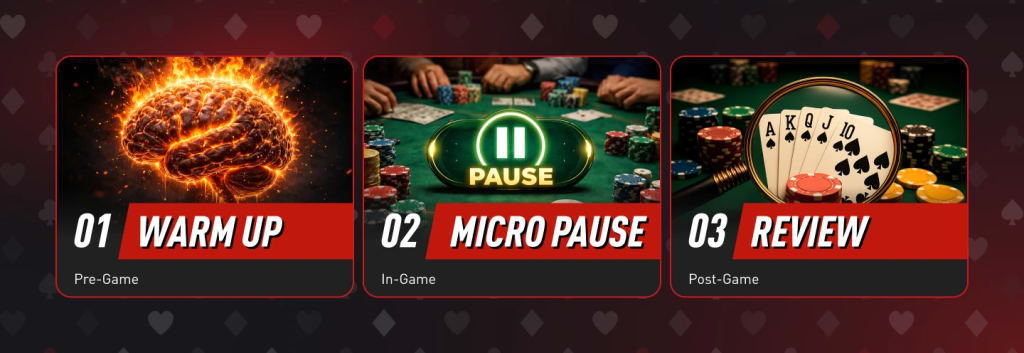
Prior To Playing: A Mental Warm-Up
Poker players benefit from a brief mental pre-game ritual, just like football players. It’s fast, relatively easy, and includes steps like:
- Setting a goal: Make it process-driven: “Stay emotionally neutral” instead of “Win $200”.
- Scanning yourself early: Are you tired? Frustrated? Hungry? Stressed? Get ahead of it before it gets ahead of you.
- Using visual notes: Keep a sticky note on your screen that subliminally reminds you that all you need to think about for positive outcomes is “Make good decisions.”
These steps aren’t life-changing, but they will reduce variance in terms of your psychological clarity going forward.
While Playing: Micro Adjustments for Maximum Stability
During play, incorporate little adjustments to avoid emotional drifting away:
- Pause for literally two seconds before each decision. It can help.
- Check in with your body. Tight chest? Palpitating heart? These signals matter.
- Deliberate breathing can help reset.
- Check in with yourself every time tilt tries to rear its ugly head.
These poker psychology driven adjustments might feel therapeutic while increasing awareness during play, making you more focused and harder to exploit.
After Playing – Review Without Judgement
It’s important to check in with yourself after every session, but only when it’s not about punishing yourself emotionally. Post-session reviews shouldn’t feel like a court hearing but like detective work that’s inquisitive and grounded in evidence. Leave the same behind, and use helpful review questions like:
- “What did I do based on emotion?”
- “Where did I feel most confused?”
- “Which hands need further analysis?”
It’s not about beating yourself up; it’s about doing your due diligence to understand your rationale, then using that information to improve in the future.
Your Mind Is The Most Powerful Hand You’ll Ever Play
Poker doesn’t care if you’re perfect. It cares if you’re flexible enough to adapt to situations, honest enough to admit mistakes, and resilient enough to remain curious despite being bored silly.
The high-performance mindset isn’t some mystical gift but rather something learned over time if you’re willing to treat your mind as part of your poker toolkit.
So next time you’re playing, don’t worry about whether you’ll hit a monster hand. You cannot control the cards, but you can tilt the odds in your favor, and that is done through controlling your response to the cards; that is what poker psychology is about.
If you are interested in Part 2 of our article series on poker psychology, read the next chapter about Tilt, or any other of the sequence; you can find all on our Poker Psychology main page .