How to Play Badugi: A Complete Guide to Asia’s Favorite Lowball Poker Game


Imagine an upside-down world, where everything is backwards. In this world, people are born old, and as time goes by, they get younger. Trees grow from the sky towards the ground, and rain falls up from the ground to the clouds. People say ‘goodbye’ when they meet, and ‘hello’ when they part ways.
What would poker be like in this world? The worst hand would always win for sure, and the usual hand rankings would be flipped on their heads. This backwards version of poker actually exists in our reality: it is called 2-7 Single Draw, or Deuce-to-Seven Lowball.
But an even more unconventional variant evolved from 2-7 Single Draw in Asia: Badugi, where players have not one, but three draws to improve their hands, and even suits matter. And of course, as it is still a lowball game, the lowest possible hand wins.
Whether you’re an experienced poker player or a curious newcomer, Badugi offers a crazy twist on the classic lowball game and dynamic battles for everyone.
In our comprehensive guide, we aim to take you through Badugi’s history, its rules, similarities and differences with other lowball variants, common pitfalls, and also provide you with basic and more advanced strategies to help you get started.
A Brief History of Badugi
Badugi’s roots are not as well known to us as Texas Hold’em’s or even 2-7 Single Draw’s history. The game probably appeared for the first time in Korea, where it was known as ‘Baduk-i’ (바둑이), a term referring to the black-and-white patterns of the traditional board game Baduk, also known as Go.

Badugi crossed the ocean in the 1980s, but it did not become particularly popular in the United States until the online poker boom of the early 2000s . Today, Badugi is not only popular in Asia but also a staple of mixed-game formats like H.O.R.S.E. and Dealer’s Choice everywhere.
The Rules of Badugi
As opposed to Texas Hold’em or Pot-Limit Omaha, Badugi is a ‘closed’ game, in the sense that players only see their own cards. Because there are no shared community cards, bluffing and hand-reading become even more important than in community card games.
Badugi is similar to 2-7 Single Draw, where the lowest hand wins, but there are quite a few differences as well. In this game, there is more than one draw; in fact, Badugi is a triple-draw, lowball poker variant, where players have three chances to improve their hands. There is also another twist: it is not enough to have the lowest possible hand; the cards need to be of four different suits, too!
Badugi can be played with 2 to 6 players using a standard 52-card deck. Players have to make the lowest possible four-card hand with all different suits and no pairs by discarding from their hands and drawing new cards from the deck to replace them.
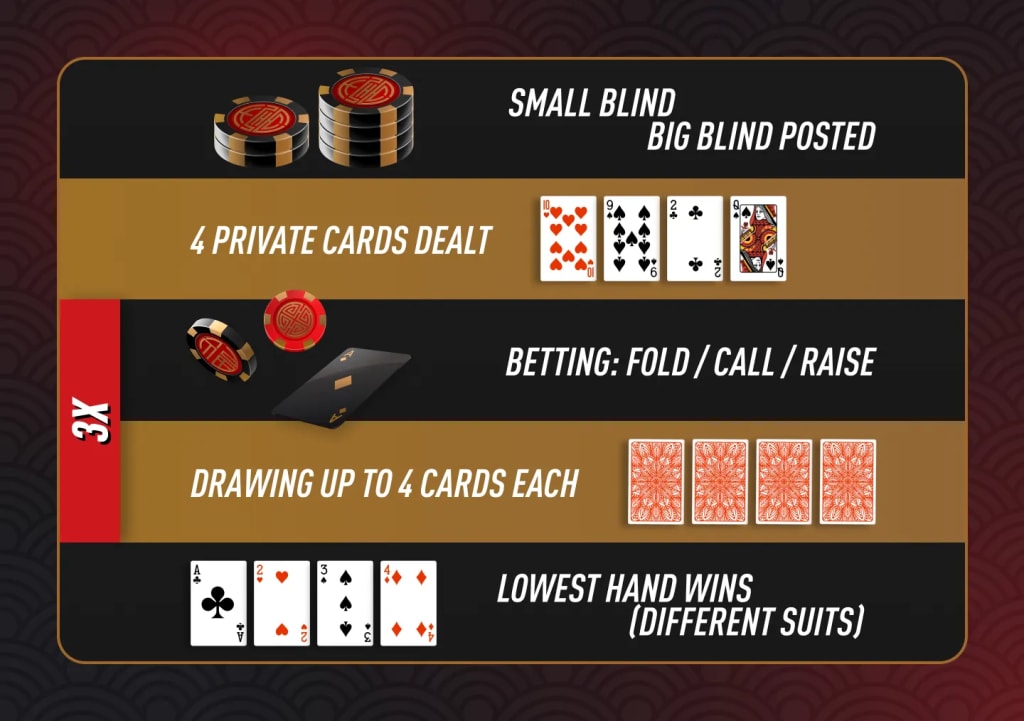
Before dealing any cards, the two players to the left of the dealer must post mandatory ‘blind bets’ called the ‘small blind’ and the ‘big blind’. The purpose of these blind bets is to ensure there is always some money in the middle to incentivize player action. Some games might include ‘antes’ too, which must be posted by every player in the hand, not just the blinds.
When the blinds are posted, each player is dealt four private cards face down, and the first betting round begins.
Players can either:
- throw their cards away or ‘fold‘
- put in the same amount of money as the big blind or ‘call‘
- put in more money than the big blind or ‘raise‘
After all players have acted, they can choose to discard and replace up to four private cards from the deck, or ‘stand pat’ if they want to keep all four of their private cards.
After all players have acted, a second round of betting ensues. After this second betting round, another drawing round, followed by another betting round happens, then a third drawing, and a final betting round. When all this concludes, the remaining players reveal their hands, and the best Badugi hand wins the pot.
Badugi Hand Rankings
To evaluate their own and opponents’ hands, players need to be familiar with the hand-ranking hierarchy of the game. Remember, everything is backwards compared to the classic poker hand rankings; a straight or a flush is terrible in this game!
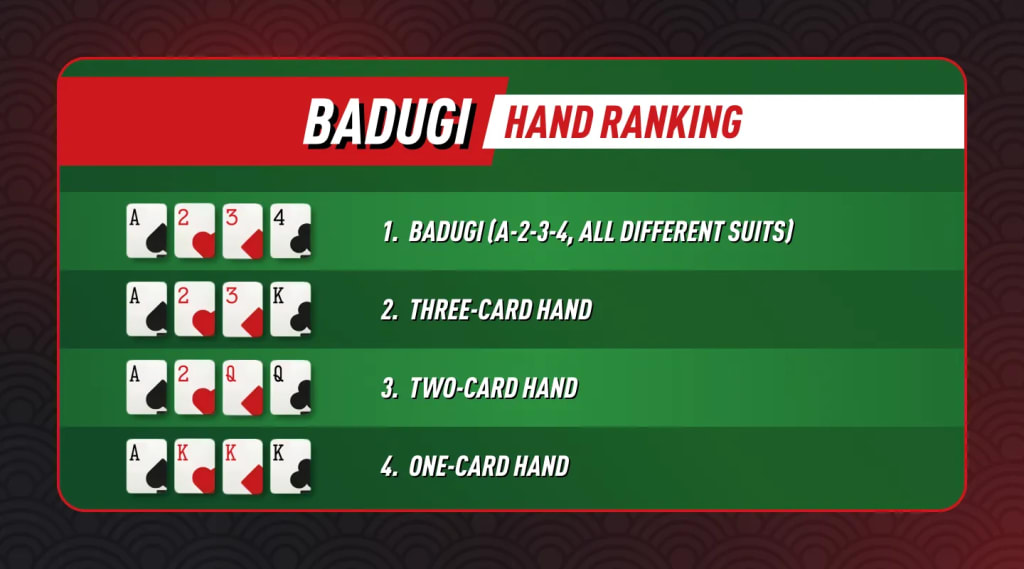
Here are the rankings for every possible combination, sorted from highest to lowest:
| Hand Type | Example | Explanation |
|---|---|---|
| Badugi (A-2-3-4, all different suits) | A♠2♥3♦4♣ | The best possible hand—four unsuited, unpaired low cards. |
| Three-Card Hand | A♥2♥3♦K♠ | If you can’t make four unpaired cards, the lowest three-card combo wins. |
| Two-Card Hand | A♥2♥Q♦Q♣ | If two cards are paired or suited, only the lowest two count. |
| One-Card Hand | A♠K♥K♦K♣ | If three or four cards are paired/suited, only the lowest single card matters. |
Basic Strategies & Tips for Badugi
Badugi is a game of incomplete information: players only see their five private cards, not their opponents’. Because of the nature of the game, reading opponents, dealing with unknown factors, and managing risk are just as important as the player’s own cards.
Here are some essential strategies to help you get started:
Starting Hand Selection
In the long run, some hands perform much better than others. You should take the time to carefully evaluate the strength of your cards before betting or drawing. The best starting hands include A-2-3-X (where ‘X’ is any non-pairing, non-straight card), especially with four different suits. It is also good to play three low unpaired cards, such as 2♥, 3♦, and 4♠. Let go of weak hands like high cards above 8 or multiple suited cards even before the draw in order to avoid costly mistakes on later betting rounds.
Have a Good Drawing Strategy
Having a good drawing strategy is essential in Badugi. On your first draw, you should be aggressive and discard high or duplicate-suited cards. On your second draw, if you are only one card away from a badugi, stand pat or keep all four of your cards to show strength, basically pulling a semi-bluff. On your third draw, you should fold weaker hands unless they have a strong three-card draw.
Drawing Is Information
Because there are no community cards, the only information your opponents can get about your hand is based on how many cards you choose to draw. If you stand pat or keep all four of your cards, it signals strength, often a Badugi, and you can often force folds with it. If you draw one card, it often means that you are close to a strong low. If you draw two or more cards, it suggests that you have a weak hand. Be careful, because all these can be deceptive bluffs as well!
Apply Controlled Aggression
You should play tighter and only enter pots with premium low draws from early positions, but you should steal blinds with well-timed bets from late positions, especially if your opponents display weakness. You should bet heavily to push out weak draws when you have a strong three-card hand.

Advanced Tips & Tricks for Badugi
Semi-Bluff When You Can
Semi-bluffs can be really powerful in Badugi. For example, if you have a three-card 7 or lower, betting very aggressively can often force your opponents to fold their better hands. Or you can represent an already made Badugi by standing pat on the second draw, when in fact you only hold 2♠3♦5♥K♣.
Profile Your Opponents
Pay careful attention to your opponents’ actions and assign them to player categories. Calling stations call too often, so you should value bet them a lot. Nits fold under pressure, so you can easily bluff them off marginal hands. Maniacs overbet their weak hands, so you can trap them with your strong holdings.
Balance Your Range
If you only bet your strong holdings, players might quickly find out about your strategy. You should avoid being predictable by mixing strong hands as well as bluffs in your betting patterns. This was, your opponents will have more difficulty exploiting your strategy.
Give False Tells
You can misdirect your opponents by acting weak with your strong hands or acting strong with your weak hands.
Common Mistakes to Avoid in Badugi
There are countless pitfalls in poker. Be easy on yourself if you make a mistake – even experienced players make them from time to time, especially when they transition to Badugi.
Identifying potential pitfalls reduces the risk of falling into them. Here are some mistakes you should look out for:
Overvaluing High One-Card Hands
With all the drawing going on, you are not very likely to win with high one-card hands, even though many players think that a single Ace is enough. In reality, you need multiple low cards, and you should only continue if you have at least two strong low cards.
Ignoring Suit Duplication
In Badugi, hands with two cards of the same suit may look quite decent, but they can in ruin your hand. You should always discard duplicate suits first.
Chasing Weak Three-Card Hands
Drawing to a 7-6-5 might look like an appropriate goal, but it is often a losing play. You should only chase draws if your three-card hand is very strong, like 2-3-4.
Failing to Bluff in Position
If you play in a passive way, you basically let your opponents outdraw your hand. You should use late positions to apply calculated pressure with nicely timed bets.
Badugi vs. Other Lowball Variants
Simply put, Badugi is a more dynamic lowball game than Razz, and requires more strategic play than 2-7 Triple Draw because of its unique suit restrictions.
Here’s how the game stacks up against other popular lowball formats:
| Feauture | Badugi | 2-7 Triple Draw | Razz |
|---|---|---|---|
| Objective | Lowest 4-card hand, all different suits | Lowest 5-card hand, straights/flushes count against you | Lowest 5-card hand (A-2-3-4-5 is best) |
| Draws | Triple draw | Triple draw | No draw (stud-based) |
| Pairs/Suits | Pairs and suited cards are bad | Straights and flushes are bad | Pairs are bad, suits are irrelevant |
| Best Possible Hand | A-2-3-4 (all different suits) | 2-3-4-5-7 (no pairs, no straights) | A-2-3-4-5 |
How to Get Started with Badugi
Want to start playing Badugi, but don’t know where to start? Here are some tips to help you get ahead of the competition:
Learn the Basic Rules
Many players aren’t even familiar with the rules of the game, so knowing exactly how the game is played can already give you an edge over them.
Take The Time to Study
Being disciplined about regular study sessions is what separates great players from mediocre ones. There are many free and paid courses on Badugi online for players of every skill level.
Play Online
Playing online can improve your game fast because hands are played faster than in live poker, and you can also play multiple tables at once. This means that you can gain much more experience playing a day online than you would if you spent a day in a casino!
What is more, many sites offer low-stakes tables where you can play without risking too much money.
Start with Low-Stakes Games
When you feel that you are ready to play with real money, start playing small stakes. When you have built enough confidence there, you can safely move up to the next stake.
Ready to test your skills? Join an online poker platform like
CoinPoker
or
Natural8
to practice and compete against players worldwide. Remember, every pro was once a beginner.