Poker for Mars Mission – Helping NASA Astronauts to Prepare

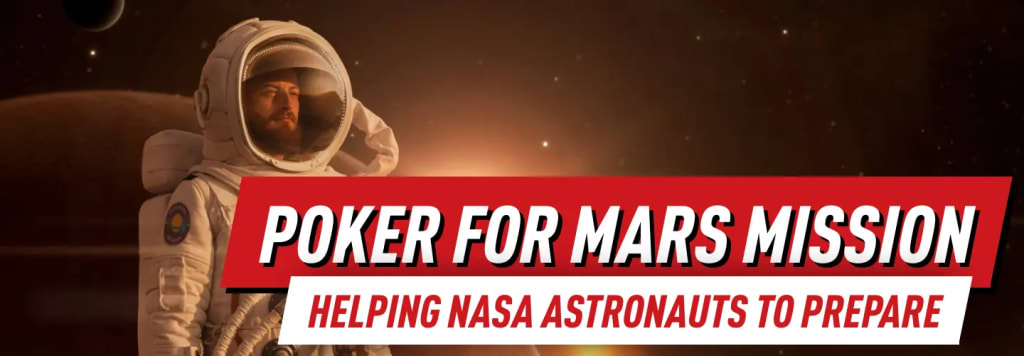
When you think of NASA astronauts training for a mission to Mars, you probably imagine complex flight simulators, underwater gravity tests, and intense physical exercise. You might not picture a group of space explorers sitting around a table, holding their cards close, and betting with colored plastic caps. Yet, this is exactly what is happening inside NASA’s Mars Dune Alpha habitat. They play poker for Mars mission preparation. A simple deck of cards and the game of poker have become essential tools for survival, bonding, and maintaining mental sharpness during long periods of isolation.
The connection between space travel and the “gambling approach” to problem-solving is stronger than you might think. While astronauts aren’t wagering real money, they are betting on their sanity, their relationships, and their cognitive skills. In the high-stakes environment of a simulated Mars mission, the skills learned at the poker table – risk assessment, reading opponents, and managing uncertainty – are proving to be just as valuable as rocket science. We might even say preparation includes poker for Mars missions.
A History of High Stakes: NASA and the Card Table
The relationship between NASA and poker isn’t new; it dates back to the very beginning of the space race. In the late 1950s, engineers at the Jet Propulsion Laboratory (JPL) nicknamed their satellite launch effort “Project Deal”. This name was inspired by the all-night poker marathons they played while driving to testing grounds in New Mexico. For these pioneers, poker was more than a pastime; it was a way to cope with the immense pressure of the Cold War space race.
This tradition continued through the Apollo era. After Apollo 11’s space mission ended and the crew returned from the moon, they had to spend two weeks in quarantine to ensure they hadn’t brought back any “moon bugs.” How did Neil Armstrong and his crew pass the time? They drank bourbon and played poker. It seems that even after walking on the moon, the grounding nature of a card game was exactly what they needed to decompress.
The Modern Mission: Inside Mars Dune Alpha
Today, the tradition endures in the Crew Health and Performance Exploration Analog (CHAPEA). This mission of NASA astronaut training takes place in a 3D-printed habitat designed to simulate life on Mars. The first crew, led by Commander Kelly Haston, spent over a year locked inside this 1,700-square-foot box. The environment is designed to be as realistic as possible, including communication delays with “Earth” and strict resource rationing.
In such an intense environment, every item brought on board must have a purpose. Space and weight are limited, so “payload” is precious. Despite these restrictions, NASA approved a deck of cards. Why? Because the psychological benefits of gaming and social interaction are critical for long-term mission success.
The Gambling Approach: Risk, Strategy, and Bonding
This is where the “gambling approach” becomes a vital training tool. Poker is unique among games because it combines skill, luck, and psychology. For astronauts, playing poker offers a safe way to practice high-stakes decision-making and utilize gambling strategy in space.
- Managing Uncertainty:
In poker, you never have all the information. You don’t know your opponent’s cards, and you can’t control the river card. Similarly, a mission to Mars is filled with unknowns. Astronauts must learn to make the best possible decisions with incomplete data. Poker trains the brain to be comfortable with this uncertainty. - Reading People:
Living in a confined space for a year can strain any relationship. Poker forces players to observe each other closely—watching for “tells” or changes in behavior. This heightened awareness of body language and mood is crucial for a crew that must rely on one another for survival. - Risk Management:
Every hand of poker involves a risk-versus-reward calculation. Should you bluff? Should you fold? Astronauts constantly face similar choices in which the crew’s safety is on the line. As astrophysicist and poker player Liv Boeree suggests, the game offers a fun yet relevant way to hone risk management skills.
Experience of the Crew
The impact of poker on the CHAPEA crew was profound. As Kelly Haston, CHAPEA Commander, said,
“There’s not much smaller or more compact than a pack of cards, right? And NASA knew this, so they absolutely gave us cards!”
Games were a way for the team to continue building new storylines and for funny things to happen. Using a game like poker for Mars mission preparation was already established, but proves be more important, than anticipated. Ultimately, they found it essential for both personal and professional reasons, and it also contributed to astronauts’ mental health.
Why Poker Works in Space – Key Benefits
- Cognitive Maintenance: The strategic thinking required in poker helps keep the brain sharp during months of monotony.
- Emotional Release: It provides a fun, competitive outlet that relieves stress without endangering the mission.
- Social Cohesion: It creates a shared activity that isn’t work-related, helping the crew bond as friends rather than just colleagues.
- Resource Efficiency: A deck of cards adds almost no weight to the payload but provides infinite hours of entertainment.
The Future of Martian Poker
Will we see a “Martian World Series of Poker” anytime soon? Probably not. As Liv Boeree points out, the transmission delay between Earth and Mars (up to 22 minutes) would make online play impossible. However, for crews stationed on the Red Planet, a physical deck of cards will likely be standard equipment.
“Poker’s inherent uncertainty mirrors the unpredictability of space missions, so it could offer astronauts a fun yet relevant way to hone their risk management skills.”
said Liv Boeree, Astrophysicist and Poker Player.
The gambling approach to psychological survival – calculating odds, managing limited resources (like their makeshift chips made of reagent caps), and reading the room – is now a proven part of astronaut training. When the first humans finally set foot on Mars, they will likely unpack their rations, their scientific instruments, and a well-worn deck of cards. After all, they didn’t play poker for Mars missions to not deal a few rounds at the spot!
Via pokernews.com